Hiroaki Tanaka
Tanaka Hiroaki
Although he had aspired to pursue art since junior high school, he couldn't find what he truly wanted to paint. The struggles at university, the 15 years spent copying national treasures, and the brilliance of the sea encountered during the COVID-19 pandemic. We spoke with Hiroaki Tanaka, a Japanese painter who continues to paint the sea with countless particles of light, about his journey.
Profile
Japanese-style painter
Born in Aichi Prefecture in 1966. In 1993, he completed the Japanese painting program at the Graduate School of Fine Arts, Aichi Prefectural University of Arts. 1993~2008: Participated in the production of replicas of National Treasures at Aichi Prefectural University of Arts. In 2012, he was first selected for the 68th Spring Inten and the 97th Revived Inten by the Japan Art Institute, and in 2015, he was recommended as a fellow of the Japan Art Institute. Exhibited annually thereafter. With delicate and detailed depiction, he is always working with new expressions and techniques.
After 15 years of copying national treasures, to finding my own unique light,
"When did you decide to pursue the path of painting?"
I started thinking seriously when I was in middle school. According to his parents, at the time, he said, "I want to study painting without going to high school." However, it wasn't that I wanted to become a Japanese painter like I am now; rather, I dreamed of becoming a manga artist or working in animation—something like that. I entered the general course in high school, but my desire to paint remained unchanged, so I started attending the Art Research Institute, a prep school for aiming for art and art universities. At first, I thought it would be good to go to a private art university, but the professor at the research institute advised me, 'If you work hard, you can aim for a national or public art university,' and that's when I got serious.
"What was the reason you chose Japanese painting?"
In fact, I didn't have a strong admiration for traditional Japanese painting. I wasn't good at sculpture, nor did I like the smell of paint in oil painting, and my parents even told me, 'Please stop painting in oil.' Design also requires creativity, and I feel like it might not suit me. By erasing each piece one by one, what remained was Nihonga. At the time, I was just wondering, 'What exactly is Nihonga?'
Student days when I didn't know "what I wanted to draw"
"Was your student life at Aichi Prefectural University of the Arts going well?"
As long as the challenges were raised, things went smoothly. You are given themes like painting landscapes and people, so you just need to respond accordingly. But I hit a wall for the first time during my graduation project. Not knowing what I wanted to draw, I drew both fish and people. Even when I paint thinking it looks good, I don't truly feel it from the heart, so I end up losing my brush. Because I could respond to the given theme, I joined the classical painting laboratory. Looking back now, I might have avoided copying in some ways.
"I think copying national treasures is quite rare. How did you end up in this field?"
During my time as a ronin (a gap year student), I learned about the cultural property restoration and conservation services carried out by Aichi Prefectural University of Arts. It was also a time when I was just beginning to be drawn to the beauty of mineral pigments, so I vaguely thought, "I want to work in work related to national treasures, such as restoration and conservation of national treasures." I was planning to finish graduate school and then proceed directly to the training course, but I was rejected. On the day of the presentation, I was drinking with university professors and they said, "Are you interested in copying a national treasure? If so, I would recommend it," which was the trigger.
"It's an important job to pass on cultural assets to future generations."
It was a long-awaited dream, and I feel like my dream has come true.
"Specifically, what kind of national treasures did you copy?"
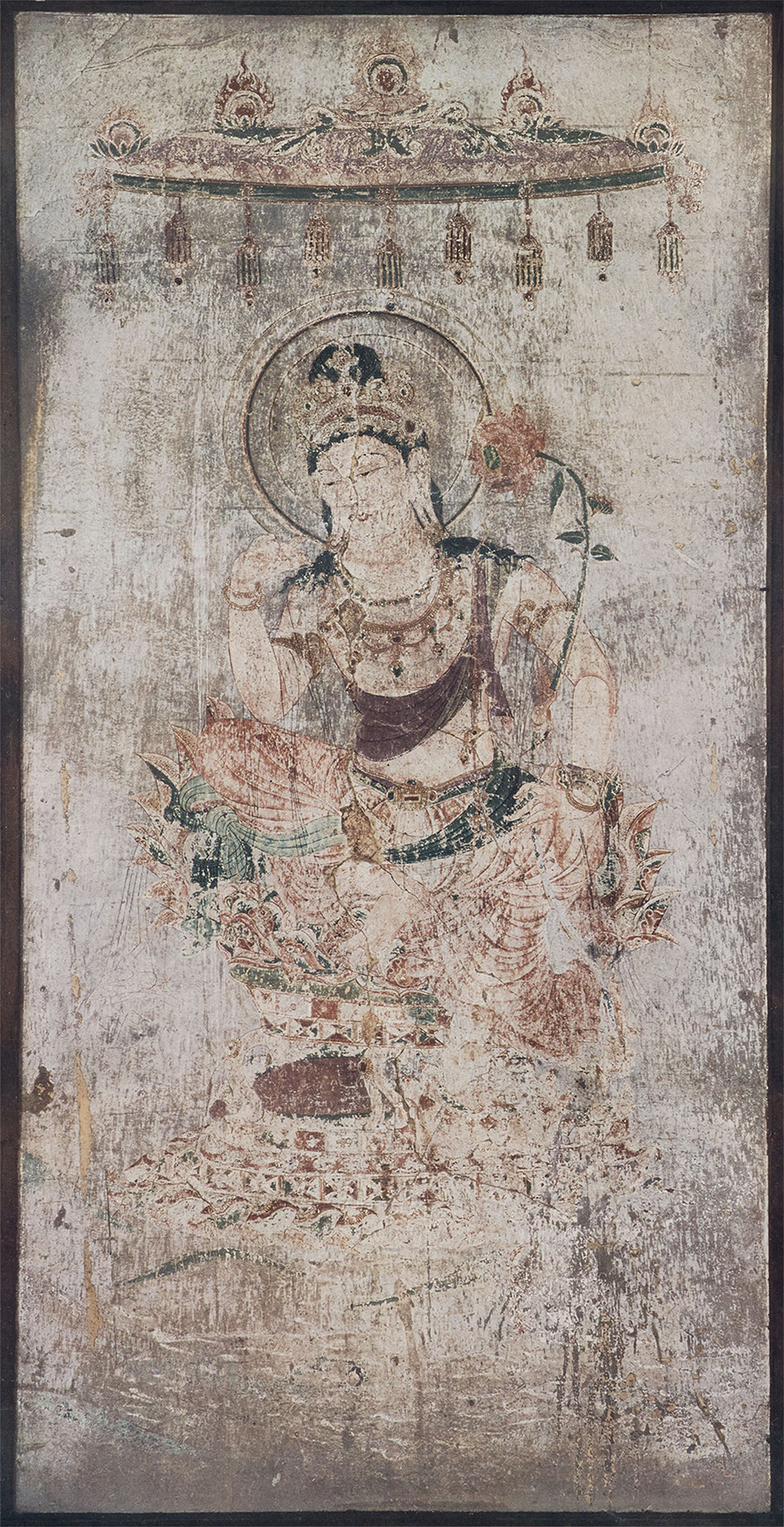
Among the Twelve Heavens of Saidai-ji, there are Moon Heaven (Gatten), Enmaten (Flame Heaven), and Ishana Heaven (Ishanaten). Kyoto's Jingo-ji Temple: Taira no Shigemori statue and Shakyamuni Buddha statue. The Kushamandara of Todai-ji. And then there's the statue of Amida at Hokke-ji.
"What makes copying so interesting?"
National treasures are treasures for the nation. Being involved in the work of copying those with my own hands and passing them down to future generations was both a source of pride and a valuable experience. But it was definitely tough. It took three years to complete a single copy, so reproducing the national treasure took an incredibly long time. I learned the technical skills, but I think I also grew mentally. When I was younger, I wanted to get results quickly, so my work was rough. However, the process for completing a replica of a national treasure is completely different. To compare it to a house, it's like doing foundation work—no matter how impressive a house is, it can't stand without a foundation. I realized that the foundation work was weak.
"By working on national treasure copying, you once again realized the importance of the basics. Did this lead to your later career as an artist?"
It's connected. When I started being selected for the Inten exhibition, a senior asked me, "What have you changed?" and I replied, "I've learned to endure." I don't rush to draw, but rather endure and steadily build up toward completion. What I learned through 15 years of copying national treasures has always been treasured in my heart like a treasure.
"What kind of person is the teacher doing?"
The moment I re-examined myself as a writer
"After leaving the work of copying national treasures, did you immediately transition to the artistic activities you do now?"
No, that wasn't the case. In my first year, I didn't have much work, but from the second year, I was offered an art lecture at a local junior high school, which led me to start teaching. I taught art at a kindergarten, and while I hadn't lost my income, I hadn't established myself as an artist either. The Inten was a bit far away, and I tried out small exhibitions, painting neat pictures with the kind of 'I hope it sells' at the time. At that time, a middle school student asked me. "What kind of person does Dr. Tanaka do?"
"That's a question that really makes you notice."
I was quite troubled by the answer to the question, "What do you do?" I painted, but I felt there was nothing else. I consider myself a painter, but when asked, "What do you paint?" I couldn't answer, and it made me realize that I still don't have a clear label as an artist. "I paint this kind of picture," there was nothing to say. I think the students asked casually, but looking back now, that question was significant.
"Did that bring changes to the work?"
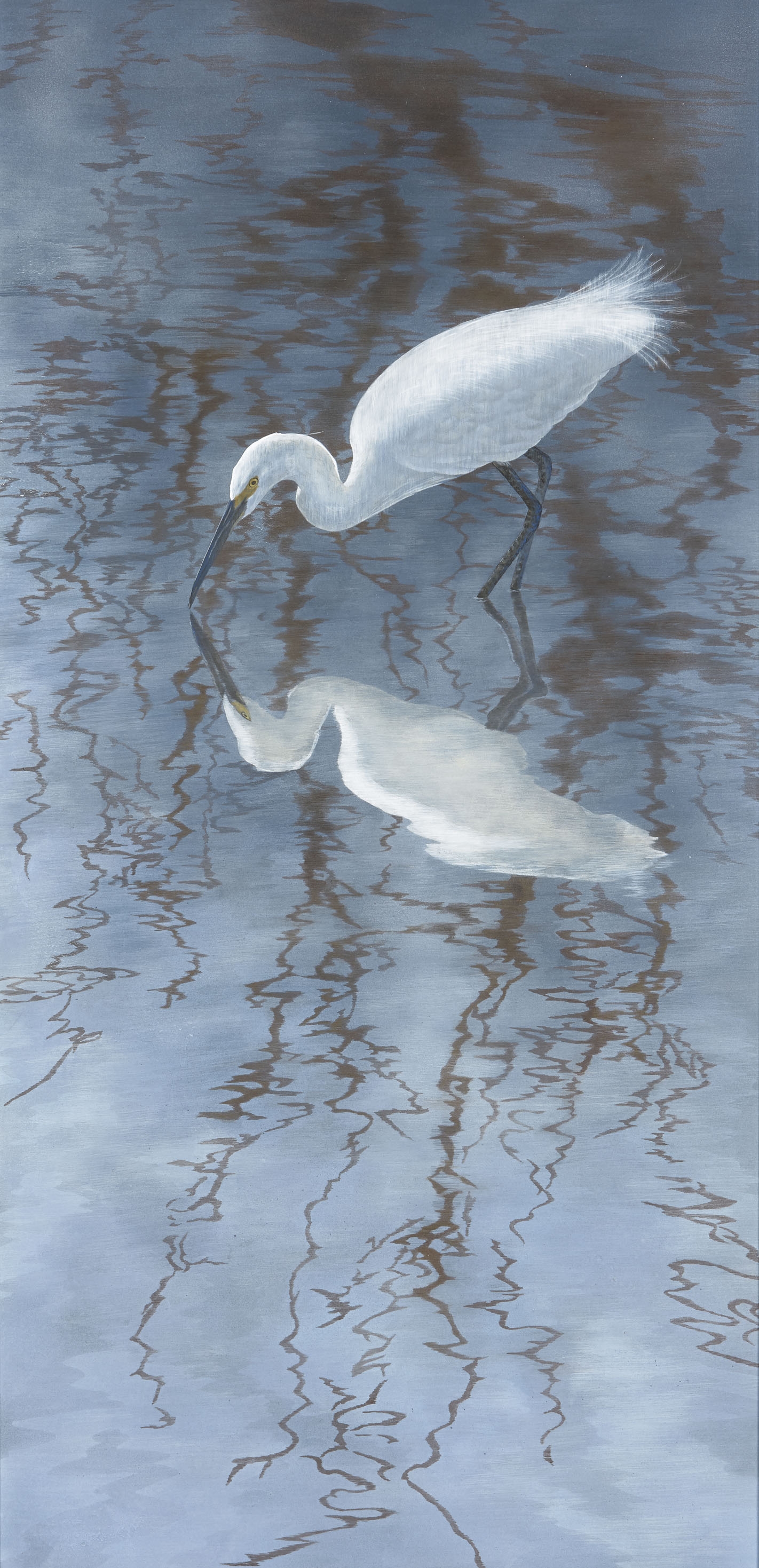
That's right. Around that time, a piece of kachofutsutsu I casually drew was suddenly selected, and the selected piece would become my research theme. I started drawing birds by the water, thinking, 'So this is my direction,' but I got tired halfway through and realized I couldn't keep drawing forever.
"What!? Why was that? ”
I got tired of it. When I draw, I put my heart into it. But when I see the works I return to exhibitions, they feel empty and empty, like they painted birds skillfully. It wasn't a technical issue, but rather that the judges saw through my lack of enthusiasm and kept rejecting me. From there, the dark age of searching for themes began. In the end, I must have struggled for about two years.
Cherishing the atmosphere and feelings of the place, painting the sparkling sea light
"Where did the ocean series, which is currently vigorously depicted, come from?"
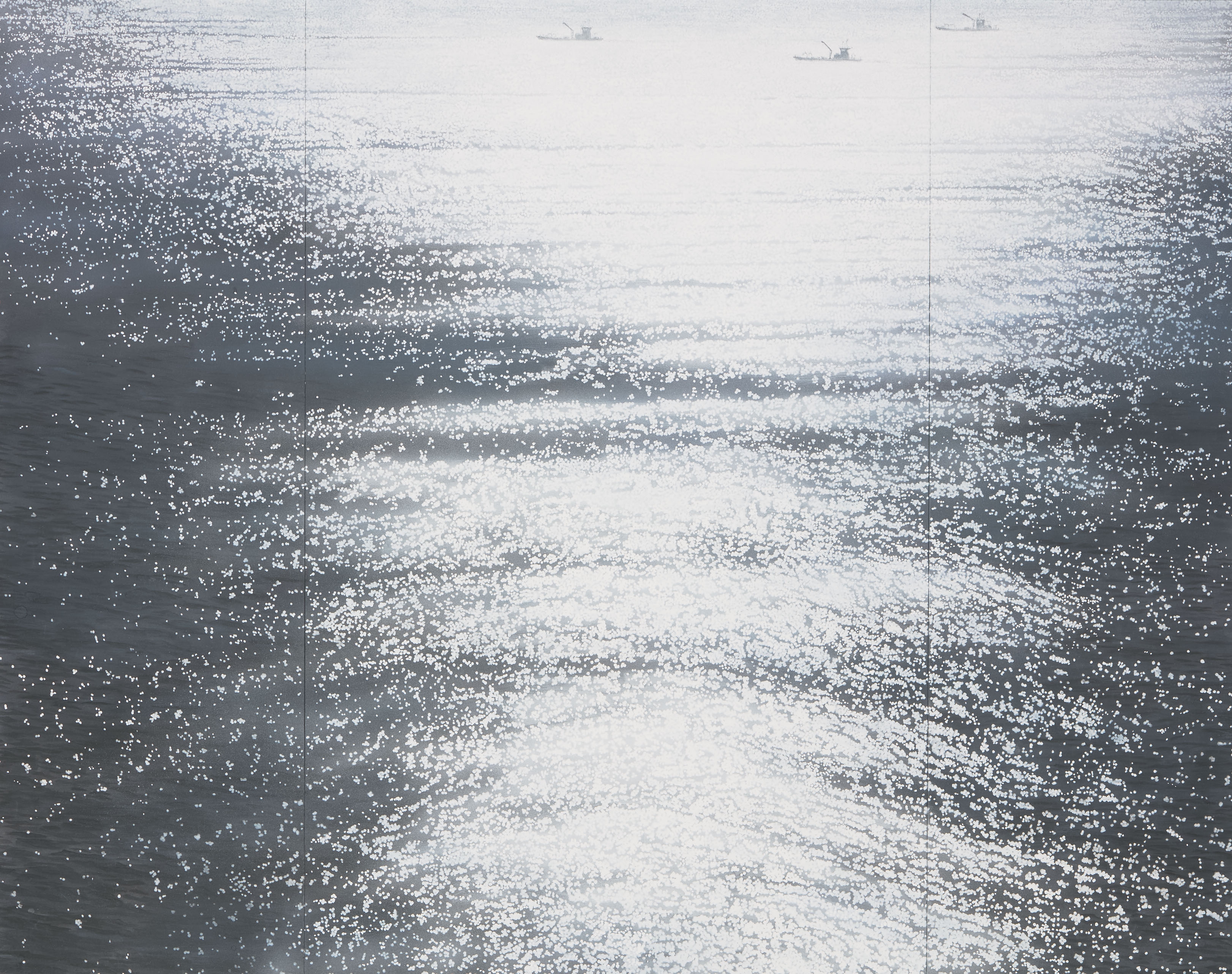
That was during the COVID era. When the whole world was feeling down, I looked at the sea. Then, somehow, I felt energized and happy. After that, when the world was receiving more gloomy news, like the war breaking out in Ukraine, looking at the sea warmed my heart and gave me hope, making me think, "Ah, I want to draw this."
"The expression of light on the surface is very striking, but how does that glow come about?"
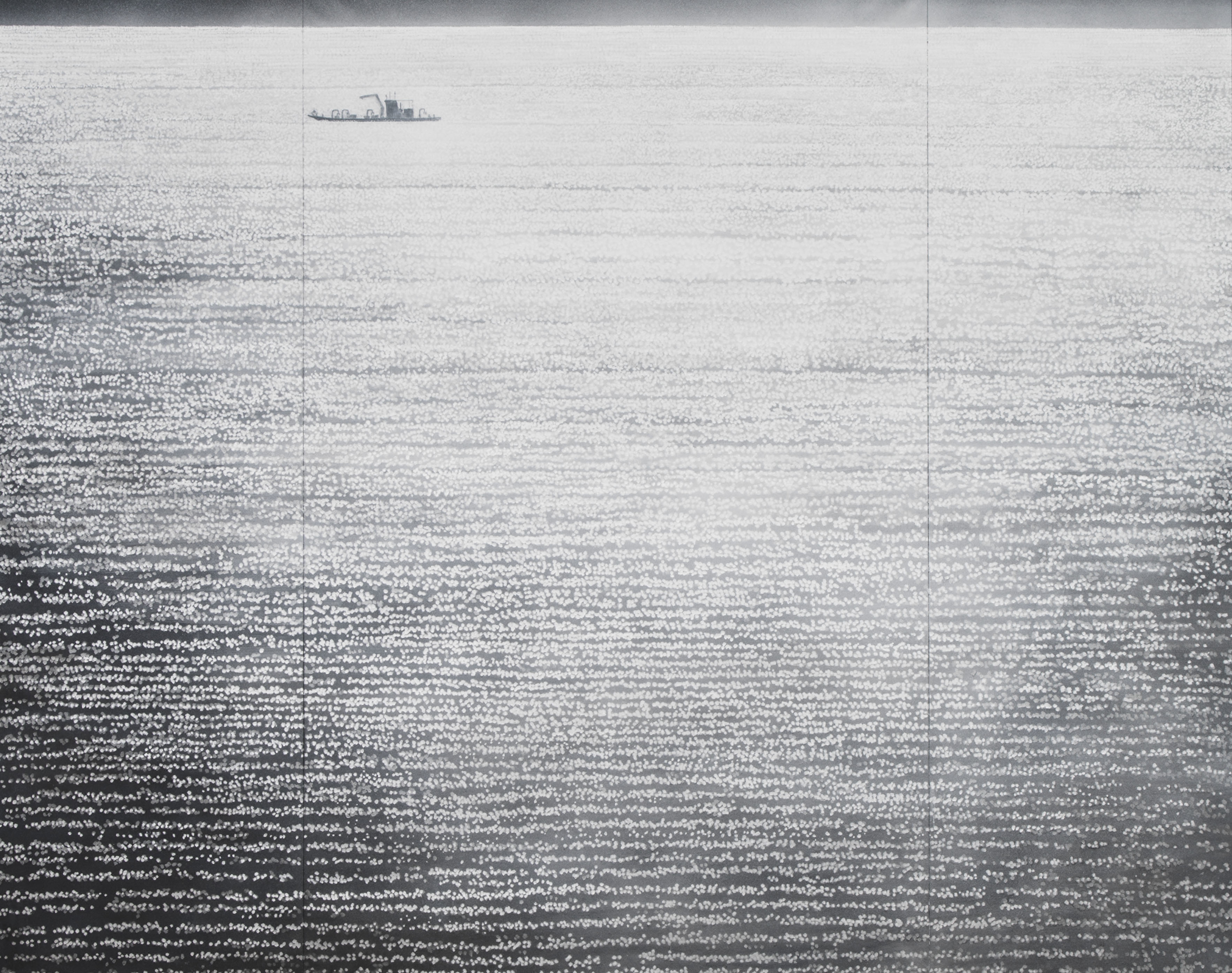
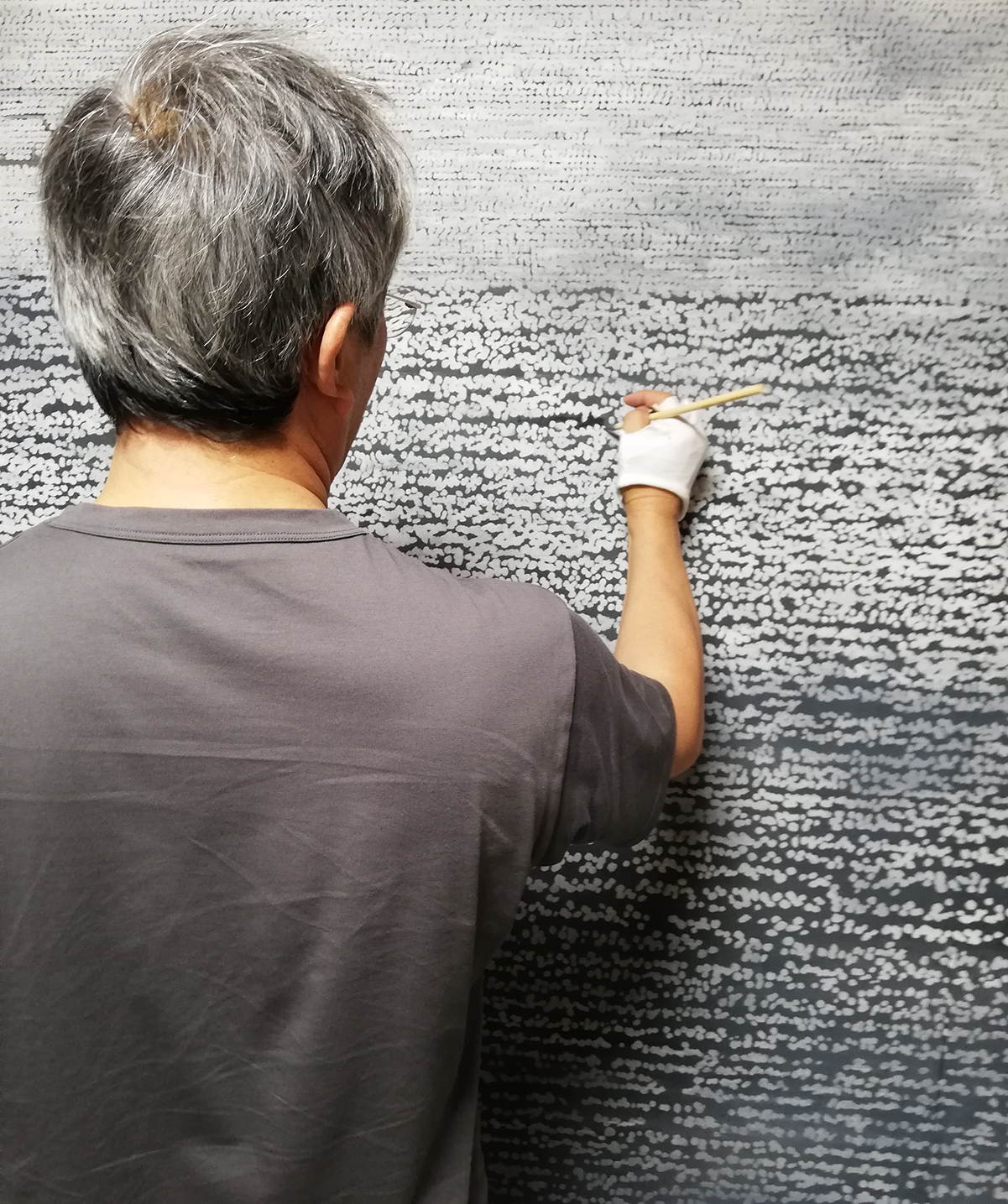
When looking at the sea, I think the most beautiful thing is definitely the light. Rather than focusing on the waves themselves, I have been thinking deeply about how to depict the sparkling reflections of light. Perhaps it's not about the sea, but about drawing light itself. Even in the same sea, the way the light enters and the waves change each time, so I try to capture the air I felt at the moment and my own feelings of "how beautiful it is." All these drawings are pointillism, so people often say, "That's tough," but I've never disliked detailed work since I was young. Ideally, you could apply it with a sticky coat, which would be faster, but that wouldn't make it light. It doesn't look like it's shining. So you gradually layer the dots, and when you do that, the light starts to float.
"So pointillism was necessary to paint light."
I tried different ways to draw, but this method was the closest to the light I saw. Draw, erase, and draw again, repeating this process many times to add depth. It's not good to just leave the surface shiny. I want depth and the feeling of light coming out of the water, so I layer it multiple times. As I learned from copying national treasures, trying to finish quickly usually leads to failure, so for now, I have no choice but to take it slow and build up each piece one by one.
"Does the light of the sea seem likely to continue as a theme to continue painting in the future?"
That's right. It feels like painting the sea, but in reality, it's like drawing something different each time, so it's endless. I got tired of the birds, but the sea is still okay. Every time I see it, I discover new things, so I think I'll keep painting for a while longer.
Solid skills cultivated through 15 years of national treasure copying, combined with the mental strength to carefully observe the subject. These efforts have come to fruition, and the "sea" Tanaka depicts shines with a unique brilliance.
Take your time and build up each dot one by one——。 The light, filled with immense time and passion, holds depth and emotion that cannot be fully conveyed by photos or words alone. Be sure to experience the breathtakingly beautiful world of light.Artist PagePlease take your time and enjoy the viewing at your leisure.