"I started drawing in the lower grades of elementary school, and there was a classroom in my neighborhood that taught painting. The school was originally a school teacher who taught art and was open on Sundays.
While attending the school of the painting until the sixth grade of elementary school, I was allowed to participate in exhibitions in the city and prefecture and received an award. I think those events have inspired me to continue painting."
Mr. Yamada said that he has been familiar with painting since he was very young. Later, when he became a junior high school student, he began to worry about his career path, and he began to feel that the path of painting was natural for him. Yamada said that when he was about the age of junior high school when he thought he wanted to paint, he was "at an age where he could see hopes and dreams."
Yamada then went to France, the home of art, to study painting at the age of 22. He said of his stay in France for about five and a half years.
"I studied painting in France. He attended an art school (Beaux-Arts) in the city where Paul Cézanne is said to have lived by painting, and then went on to the College of Fine Arts. Thanks to the terrain of France, which is adjacent to various countries, it was a living environment where I could talk to many people.
Also, while studying in France, various things came into me in a completely different way from what I felt in Japan. Whether I looked at the sea or the fruit, I felt it vividly. Of course, the taste was different. I learned in a place full of colors. 」
When I started painting
What is taken in from everyday life becomes color and shape.
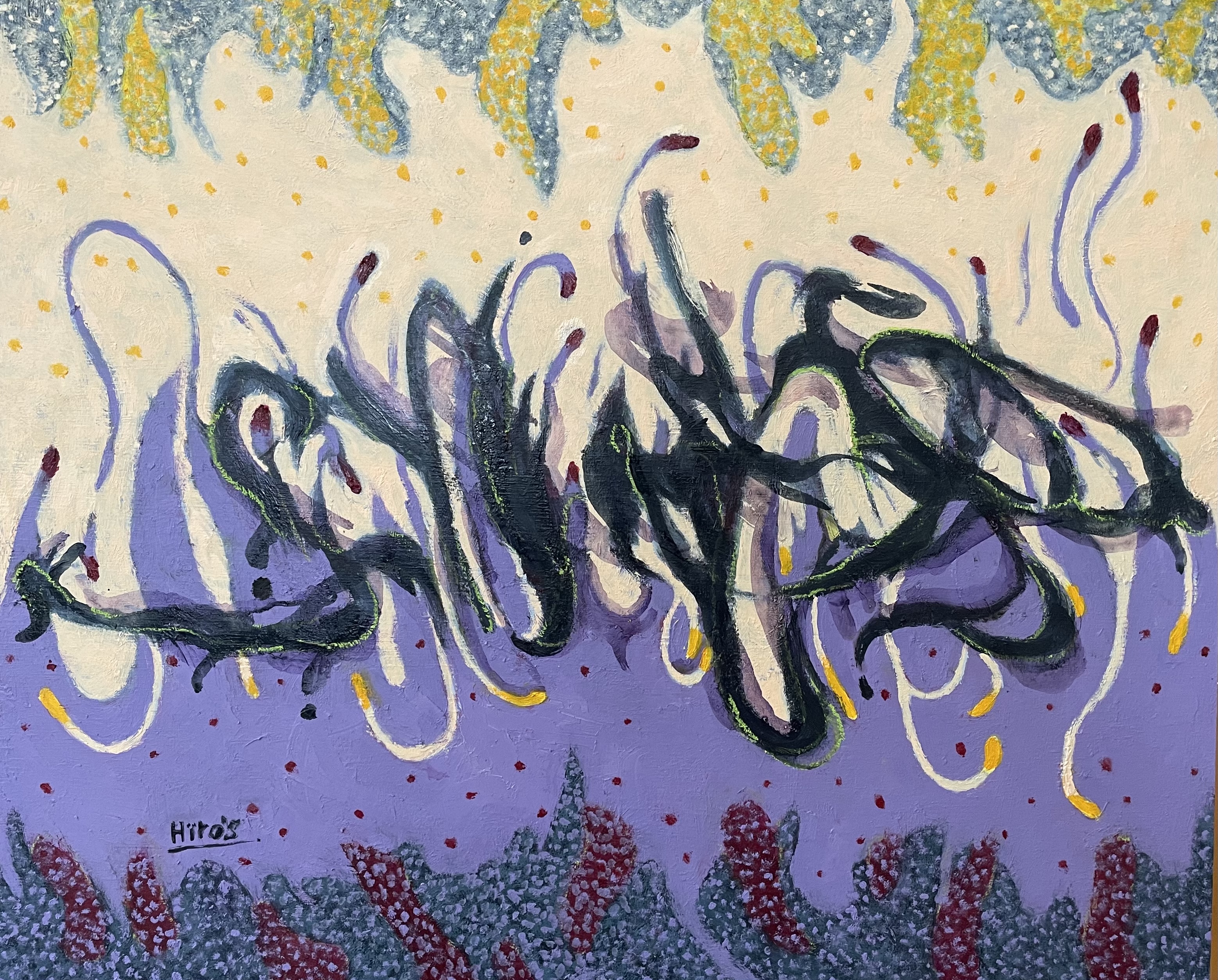
"My work is what is called mixed media. You can freely choose art materials according to what you want to express at that time. Besides acrylics, oil paints, pastels, watercolors, crayons, and pencils, newspaper collages, Styrofoam or cardboard may be used. I pursue expressions that suit me and expand the expressions I want to express in front of me.
Recently, many of them fit into a square screen, but sometimes I have created things that protrude in all directions, such as protruding the canvas in a flat direction or making it appear three-dimensionally."
When I was an art student in France, I was asked by an overseas teacher, "Where are you in this painting?" It is said that the words are still alive in that style. Many of the works he creates are abstract, and all of them are Yamada's mental landscapes. There are many motifs such as curves and circles, but all of them are drawn freehand. Mr. Yamada talked about his commitment to curves as follows.
"I returned from France and got a job at a design company. Perhaps because of the reaction to the work of drawing straight and firm lines with a ruler, there are many works that freely express the flow and undulation of curves. I draw using hand strokes. The concept is visual language. Rather than painting with motifs in front of them, they are all works that express one's emotions and vision. When you take in what you see, feel, and what happens in your relationships in your daily life, it will change into colors and shapes within you without realizing it. The title is very important because the work is abstract, but I think it would be nice if the title resonates with "my mental image" and "my feelings with the viewer."
When I was an art student in France, I was asked by an overseas teacher, "Where are you in this painting?" It is said that the words are still alive in that style. Many of the works he creates are abstract, and all of them are Yamada's mental landscapes. There are many motifs such as curves and circles, but all of them are drawn freehand. Mr. Yamada talked about his commitment to curves as follows.
"I returned from France and got a job at a design company. Perhaps because of the reaction to the work of drawing straight and firm lines with a ruler, there are many works that freely express the flow and undulation of curves. I draw using hand strokes. The concept is visual language. Rather than painting with motifs in front of them, they are all works that express one's emotions and vision. When you take in what you see, feel, and what happens in your relationships in your daily life, it will change into colors and shapes within you without realizing it. The title is very important because the work is abstract, but I think it would be nice if the title resonates with "my mental image" and "my feelings with the viewer."
A series of works dealing with common motifs
The concept of "Tears of Tears" is a variety of joys, sorrows, and sorrows that everyone feels. There are many reasons for human tears. I thought that if I multiplied my experience with various types of tears, it would become a motif. It is a series that reflects the joys and sorrows of the past, as well as my own experiences."
It is said that there are other series of works such as "Square Talk" and "Why Do You Say a Lot...". These are works that deal with the theme of both mixed and chaotic things. In particular, I thought that the collage of "newspapers", which is a crowd of information and ideas, was an interesting idea, and it left a good impression on the author even when I listened to the story.
"'Square Talk' is a series that consists of many squares on the screen, and each one has an expression by combining it, tilting it, and making it jump up. It is a work that preserves the feeling of noisy chatter with a rattling feeling. I sometimes use newspaper as a collage of squares. In "Why do you say a lot of things...", the motif is excuses that you can do and sometimes do in your daily life. Such reasoning is not a single emotion, but a very mixed feeling. The series composed of giving each thing that is squirming in your emotions has a color and shape is "A Lot of Excuses". My motivation for creating works has its roots in everyday life. From there, the goal is to make it a "visual language". I am working with the desire to express all events and atmospheres as a visual language."
It is said that there are other series of works such as "Square Talk" and "Why Do You Say a Lot...". These are works that deal with the theme of both mixed and chaotic things. In particular, I thought that the collage of "newspapers", which is a crowd of information and ideas, was an interesting idea, and it left a good impression on the author even when I listened to the story.
"'Square Talk' is a series that consists of many squares on the screen, and each one has an expression by combining it, tilting it, and making it jump up. It is a work that preserves the feeling of noisy chatter with a rattling feeling. I sometimes use newspaper as a collage of squares. In "Why do you say a lot of things...", the motif is excuses that you can do and sometimes do in your daily life. Such reasoning is not a single emotion, but a very mixed feeling. The series composed of giving each thing that is squirming in your emotions has a color and shape is "A Lot of Excuses". My motivation for creating works has its roots in everyday life. From there, the goal is to make it a "visual language". I am working with the desire to express all events and atmospheres as a visual language."